The submittal lifecycle, end to end.
Five stages, from your first document upload to a graded, audit-ready verdict on every requirement. Every stage carries citations forward, so nothing ever loses its source.
See it catch a real oneDocument Sandbox
Upload specs, drawings, contracts, and addenda. AI classifies every document and handles large spec sets cleanly — turning each page into citation-ready evidence with visible source-page highlights.
Submittal Register
Auto-generate a complete submittal register from your specs, addenda, and drawing schedules. Every row links back to the exact spec clause or drawing cell, and your team's edits and overrides survive a re-upload.
Technical Requirements
Extract every technical requirement — strengths, tolerances, standards, VOC ceilings — from Spec Parts 2 and 3, with named products grouped into submission assemblies and every numeric threshold captured with the correct comparison operator.
Submittal Pre-Flight
A subcontractor uploads a package; AI segments it into document types and a deterministic check compares it against your register checklist, telling you what is missing — auditable line by line.
Submittal Analysis
Every verified requirement is graded against the submitted package — Pass, Fail, Not Found, or Manual Review — with reasoning and citations on both sides, and a one-click PM override that is always recorded.
Every finding is wired to its source page.
A representative document set. Pick a finding on the left and see the exact clause it came from, highlighted on the page it lives on.
A sample document set built for this demo. The findings, citations, and page highlights are exactly what the product produces on your own documents.
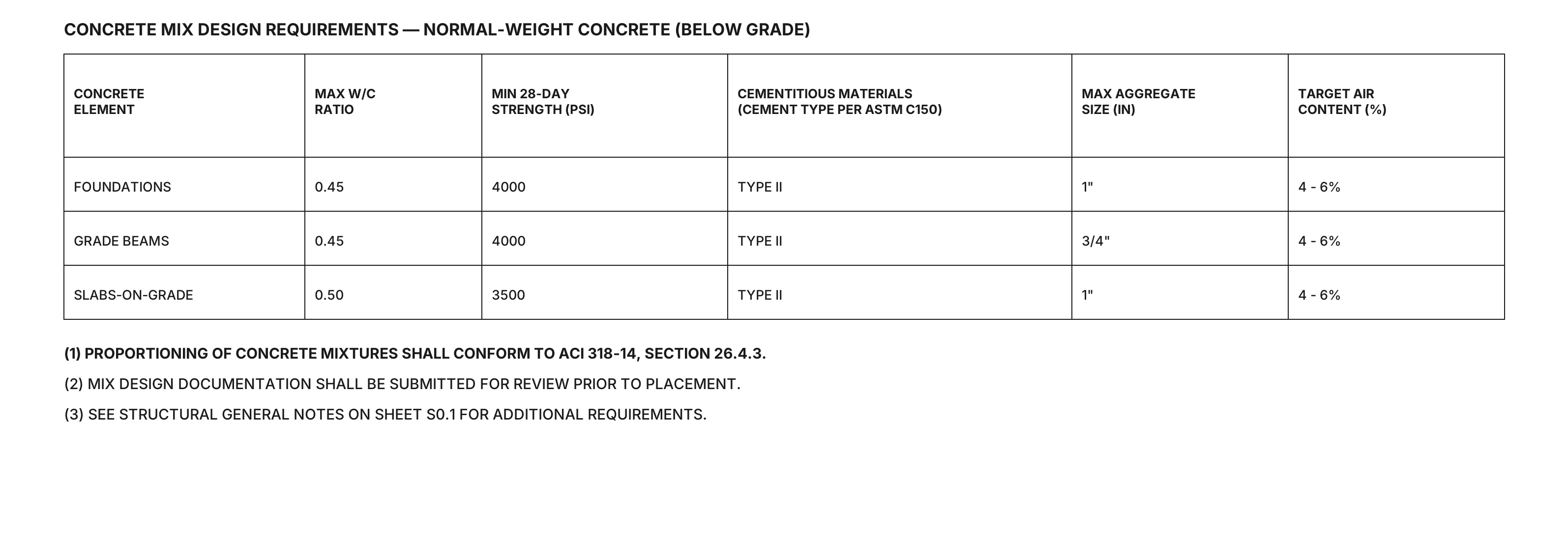
Cited source text
“PROPORTIONING OF CONCRETE MIXTURES SHALL CONFORM TO ACI 318-14, SECTION 26.4.3.”
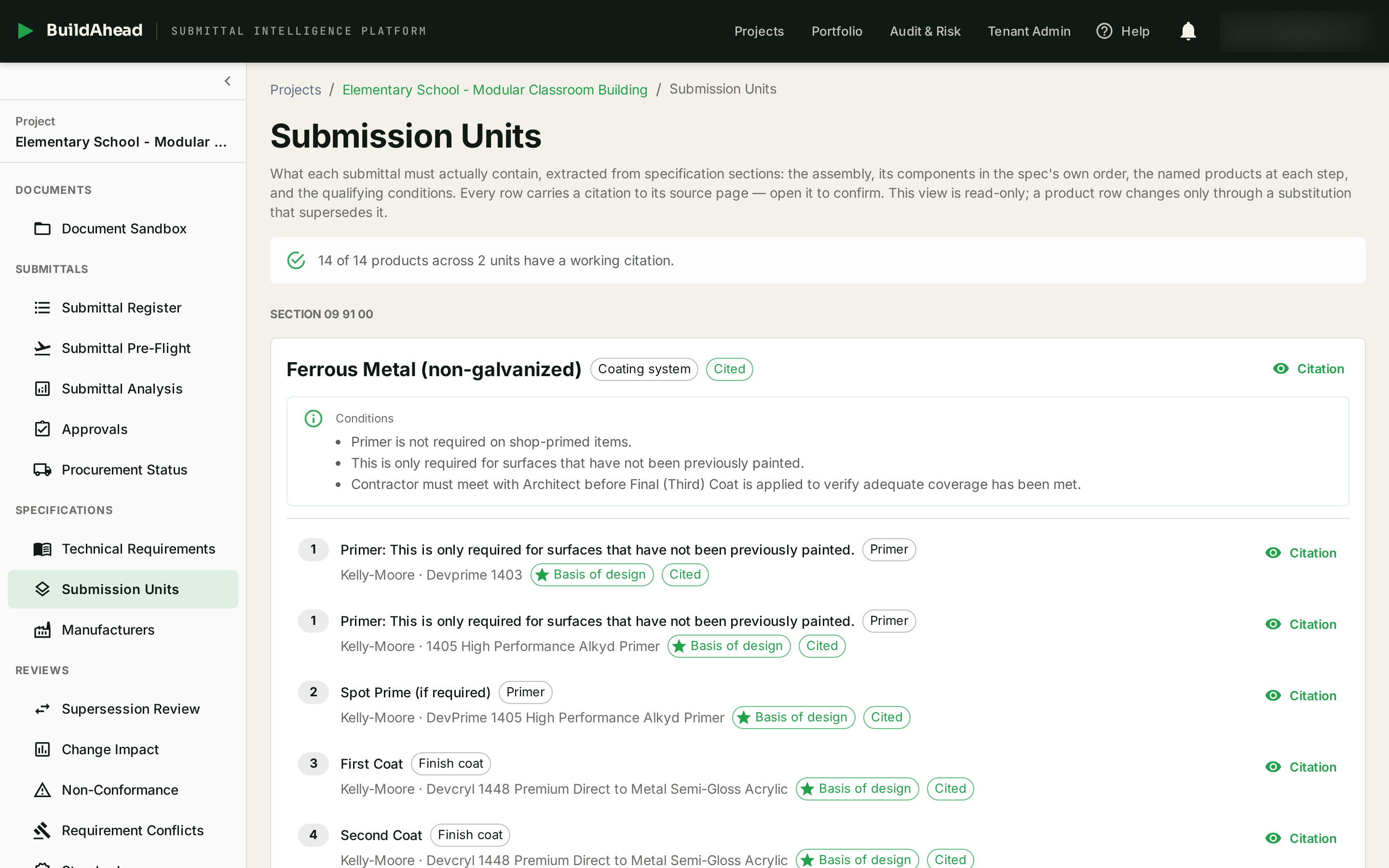
Down to the named product, every one cited.
Submission Units show what each submittal must actually contain — the assembly, its components in the spec’s own order, and the named products at each step — with a working citation on every row.
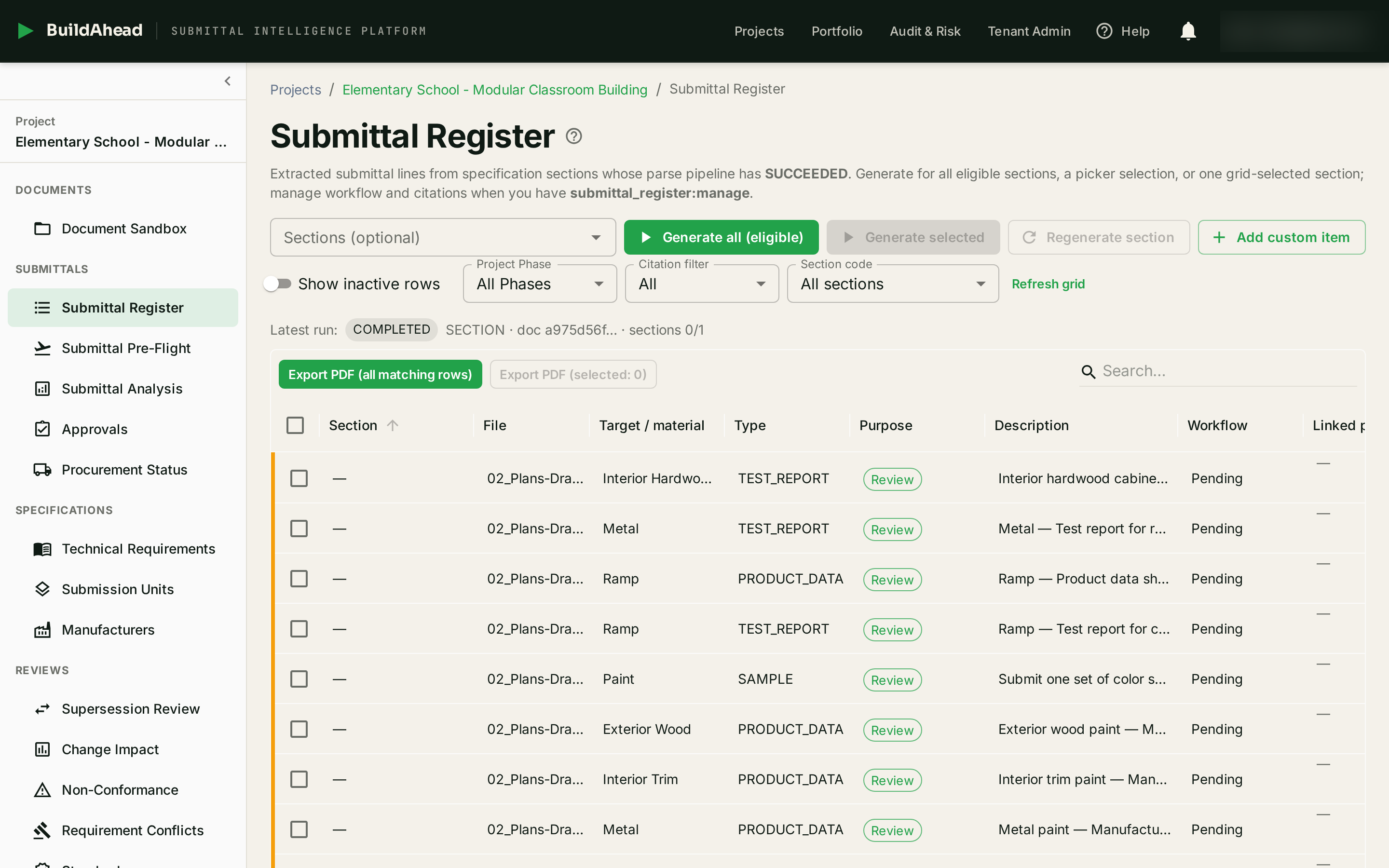
One row per deliverable, every clause traceable.
The submittal register, generated from your specs, addenda, and drawing schedules — with the workflow, purpose, and source for every line.
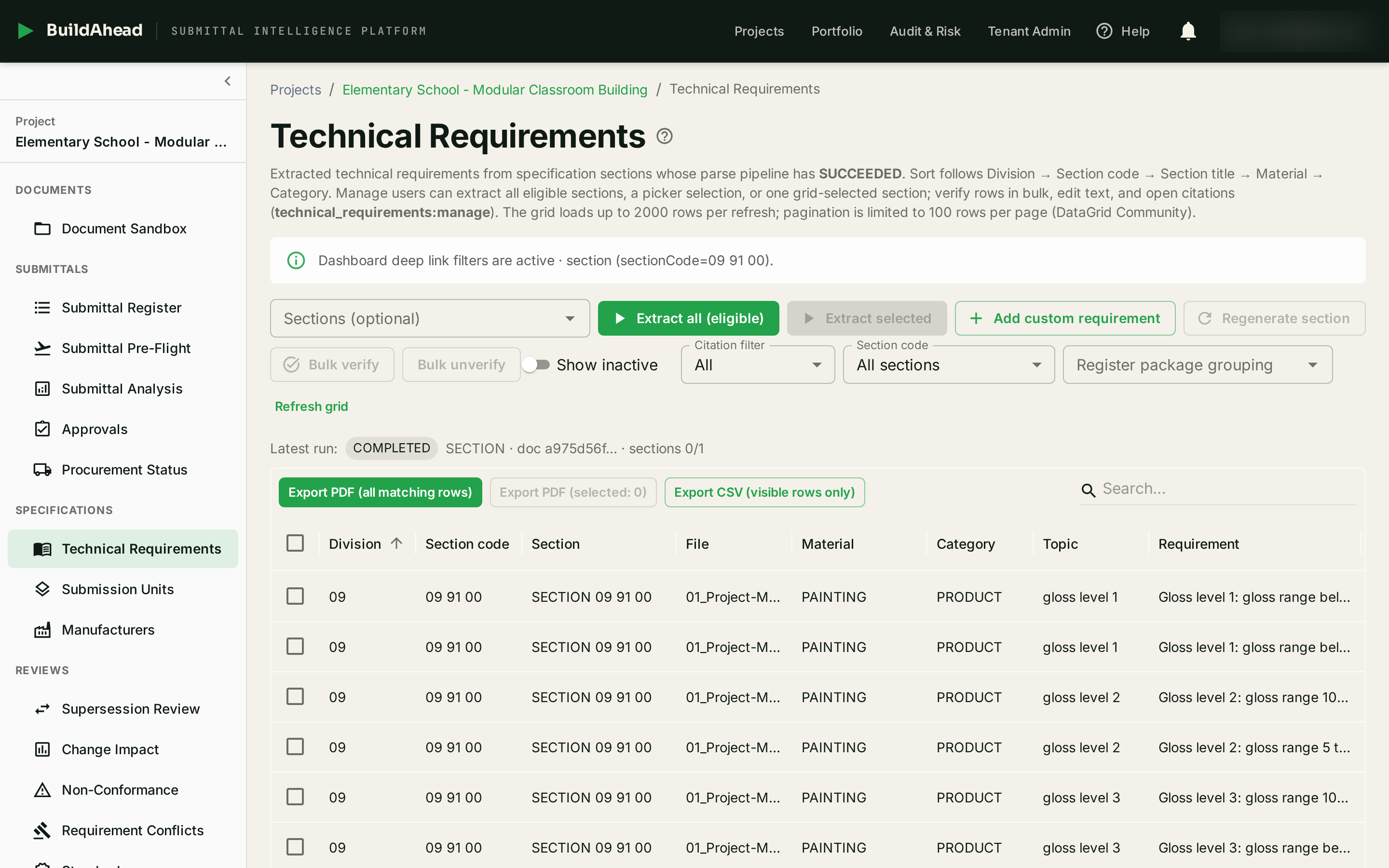
Every threshold typed, every one cited.
Technical Requirements pulls each spec requirement with its Division, section, and material intact — the measurable ones captured as numbers with the right comparison, never guessed.
What we understand today — and what we don't, yet.
Here's what's modeled structurally and citation-ready right now.
Specifications
CSI / NBS / Uniclass-aware. Part 1/2/3 hierarchy preserved. ASTM and code references kept verbatim.
Drawings
Sheet metadata parsed. Schedules extracted as structured rows that feed the register. Reconciled against specs automatically.
Contracts
AIA and FIDIC detected. Precedence-aware downstream.
Addenda
Linkage and supersession tracked across the spec set. Change impact surfaced automatically.
Submittal Packages
Segmented into Product Data, Shop Drawings, Certificates, Test Reports, Warranties, O&M Manuals, and LEED Docs.
Live today. Clear about what's next.
The submittal lifecycle is live. Here's what's in active build, and where the platform is headed.
Per-project command center — register readiness, procurement, and risk in one view
Cross-project portfolio visibility for program health and subcontractor performance
Change-management workflows on the same citation-backed engine
Billing reconciliation across SOVs, approved changes, and prior periods
Multi-agent workflows that span the full project lifecycle
Integrations with Procore, Autodesk Build, CMiC, Sage
Predictive risk and schedule forecasting
Every decision is yours. Every decision is traceable.
- Citations carried from parse to verdict
- Append-only audit trail, immutable by design
- PM override on every decision, always recorded